Press Quotes 2025+
Jon Rose
what others say
Despite the collapse of serious cultural debate in mainstream media, this page consists of descriptive reviews from The Guardian, The Wire, The Voice, The London Times, Realtime Magazine, Squidco, Down Town Music Gallery, Cyclic Defrost, All About Jazz, and many more.
'Rose on violin and tenor violin and Dresser on four-string and five-string basses, both with their unique extended bowing techniques, often sound like a chamber orchestra, creating a much bigger sound than just a violin and double bass, and bursting with so many ideas - brutal and provocative, subversive and playful, emotional and brilliant but always captivating. The music flows with natural ease, passion, and deep listening and suggests highly resonant and instant compositions. The improvisation with Tarasov opens Rose and Dresser’s dynamics for a more introspective, subtle interplay.
Band Width is a highly stimulating collision of rich musical universes articulated by two masters of the highest degree. It demands repeated listening to explore and appreciate its myriad wonders.
Percorsi musicali (Italy)
'The music on this release is mindblowing. Jon plays the violin and the tenor violin. Mark plays double basses with four and five strings. This is hyperkinetic and hyperfocused music, where a lot happens simultaneously, resulting in restless music. There’s much to digest here, with no rest for the wicked. Things settle down in the last track, the one with Vladimir joining the festivities. This is improvised music but could easily be played in a classical setting. There’s really no distinction here. Excellent stuff!
Vital Weekly
'One thing about Jon Rose is that he has a quirky sense of humor, which seems to affect the way some listeners take him seriously. As far as his experimenting and exploratory chops go, he is a serious improviser. Right from the opening, it seems hard to believe that this session/disc was recorded from two locations on either side of the world. The first piece erupts intensely with both string players creating a brutal, brittle soundscape...Together these two string giants are pushing and pulling, bending, bowing, banging on the strings and creating their own world or sonic soundscape. I like the way the textures and interplay keep shifting, quicker, slower, more sparse, more dense, each shift seems to create a different vibe or inner scene. It often sounds like these explorations are endless since they keep changing, playing games with our expectations. There is also a fascinating balancing act going on here as the duo go in opposite directions yet find a common area, matching each other’s path or sound at times. I find that the results of what these two are doing is consistently fascinating and filled with many unexpected twists and turns.
Down Town Music Gallery (NYC)
'Rose - an Australian with a passion for the violin that he loves to play and manipulate in the most varied ways; Mark Dresser does the same with the double bass. From some smart working sessions come these tracks in which the two show off their technique, extracting the most disparate sounds from their instruments that still remain very recognizable. As usual in the free field, you never know where the rescue is going in a succession of acrobatic performances. Although rhythms and melodies are at least impeded and even in the calmest moments a certain frenzy can be perceived, the result has its own rigour and, for ears that love experimentation, also its listenability. In the last track, the Lithuanian percussionist Vladimir Tarasov also intervenes.
Blow Up Magazine (Italy)
'Rose and Dresser begin their dialogue in an almost free jazz environment. Dense, juicy phrases, effective short circuits and build-ups...The action changes frequently, aesthetic surprises lurk around every corner. The second part is again marked by post-jazz gimmicks, but it gets most interesting when the musicians move on to full-blooded preparation of their instruments. The third part is dominated by intimate contemplation, saturated with expressive lamentation. At any moment, the musicians are able to switch to a full dynamic and free-form dance mode. They phrase arco, and after a moment they pluck the strings at a half-gallop. They riff and, exhaling, almost on their knees, they offer mysterious prayers. For a moment they descend into a deep crypt, and after a moment they reach for the sky with the high timbre of heated strings. In the seventh movement, they first summon a hot wind from the south, then drown in inconsolable sorrow. And they effectively sum it all up in the last, over ten-minute piece, in the middle of which the drummer enters the game and marks every fragment of the road they encounter with a stream of post-jazz incorporations.
Spontaneous Music Tribune (Poland)
'What happens when two avant-garde string sorcerers - separated by continents, decades, and enough deserts to make Lawrence of Arabia blush - finally bridge the gap using cutting-edge technology? The answer lies in "Band Width", a startlingly inventive album that feels both improbably futuristic and gloriously tactile. Jon Rose and Mark Dresser have created an improvisational dialogue that stretches not just across time zones but across the outer limits of their instruments, their imaginations, and perhaps even reason itself.
Rose, the Australian maverick of the violin, has spent his career turning strings into existential queries, often on instruments that look more like science experiments than tools of melody. Dresser, the Californian maestro of the double bass, brings a meticulous virtuosity that can transform a bass string into a narrative arc. Together, they conjure a collision of sounds that suggests not so much a meeting of minds as a delightful clash of wildly intelligent weather systems.
The album opens with "Bandwidth 1", an immediately captivating introduction to their world. Rose’s violin skitters and shrieks with a playful menace, while Dresser’s bass growls and murmurs like an ancient creature waking from a deep slumber. It’s not music for the faint of heart, but for the adventurous listener, it’s a portal to an entirely new dimension.
As the tracks unfold, each titled sequentially, the duo explores a seemingly infinite variety of textures and dynamics. "Bandwidth 4" feels like a study in controlled chaos: bow scrapes against strings with ferocity, and pizzicato plucks ricochet like sparks from a fire. By contrast, "Bandwidth 7" evokes a quieter, almost meditative mood, as if the instruments are taking a moment to breathe after their sonic pyrotechnics.
The final track introduces percussionist Vladimir Tarasov, dialing in from Lithuania in an audacious display of remote collaboration. Here, the album reaches its zenith of unpredictability, as Tarasov’s contributions add a percussive tapestry to the already rich palette of sound. It’s as if the three musicians are orbiting the same musical star, each pulling the gravitational forces in unexpected directions.
What’s most astonishing about "Band Width" isn’t just the sonic inventiveness but the sheer audacity of its creation. This is music born of the pandemic, a project that turns the necessity of distance into a creative advantage. Thanks to the SonoBus software, latency - the bane of all digital musicians - becomes a mere footnote. The tyranny of geography vanishes, leaving only the pure act of improvisation.
And yet, there’s a touch of irony to the whole endeavor. Here are two musicians who, for decades, rarely found themselves in the same city, let alone the same room. Now, with the world more connected than ever, they’ve built an album across literal oceans. It’s a testament to human creativity that technology, often blamed for eroding intimacy, has instead forged something profoundly personal and immediate.
To call "Band Width" a jazz album would be reductive; it’s more like a sound laboratory where experiments are conducted with reckless curiosity and impeccable skill. At times it feels like a conversation, at others a heated argument, and still others like a shared joke between old friends who’ve spent years perfecting the punchline.
This isn’t music for passive consumption. It demands attention, rewards curiosity, and offers the kind of thrills that only come when virtuosity meets vulnerability. As Rose and Dresser pull and prod at their instruments’ limits, they reveal something larger: the limitless possibilities of collaboration, even when stretched across half a planet.
In "Band Width", Rose and Dresser remind us that improvisation isn’t just an act of music - it’s an act of faith. Faith in the connection between players, in the tools of the trade, and in the ears of a listener willing to embrace the strange, the chaotic, and the sublime.
Chain DLK
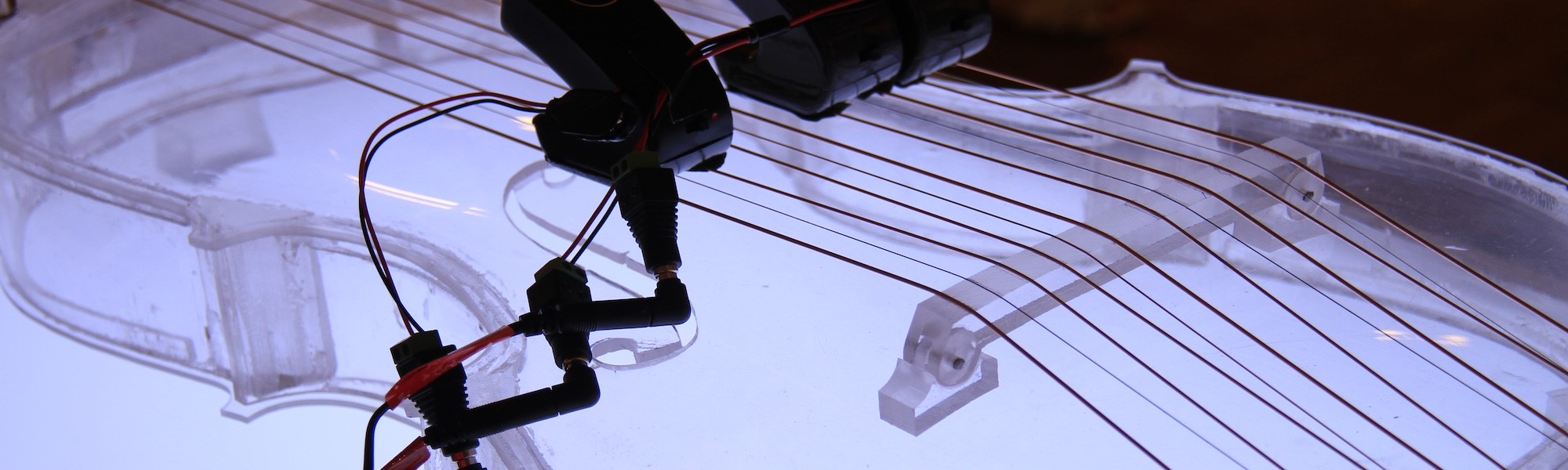
'The car itself was remodelled by maverick musician Jon Rose, building on his acclaimed project Wreck, which saw decaying vehicles transformed into powerful, amplified sound sculptures. ‘He welded two bonnets on to the roof; a cheeky wink to the opera house sails because, of course, this car is an Aussie icon,’ says Mahoney. ‘There’s another bonnet on the back of the car… and four fence wires that together create this resonant wall of sound.’
Tonight is just the beginning of its itinerant journey south, with the month-long tour of art, sound and performances weaving across 3,456km and 12 stops from Kununurra to Perth, where the car wreck – which travels on a trailer towed by a ute – will go on permanent display at the WA Museum Boola Bardip. The intercultural collaboration features Gija, Miriwoong and Yamatji artists alongside non-Indigenous performers.
‘It’s an incredible sound. It’s visceral, it’s bassy and it’s rough, but that’s its beauty – it’s the opposite of a pure violin sound. Some of the Gija artists said it sounds like their Country.’
The Guardian
'In other words, the exceptional skill of these gentlemen cannot be limited by ordinary boundaries. However, this is contingent upon the listener's ability to keep pace with the breakneck succession of dynamic vignettes and dissonant shards that define the eight tracks. Additionally, in absence of conventional tones or harmonics, Rose and Dresser produce splendidly preposterous noises by extended bowing techniques. This caused yours truly to envisage rosin particles being propelled from the bow hairs across a range of deviant sonorities.
Ultimately Rose, sounding as a struck-by-lightning Stephane Grappelli trying to reproduce Anton Webern's entire collection of string quartets in three minutes, or Dresser making his 4- and 5-string basses grunt, roar, sing deep and shudder like earthquake, will be fully appreciated by those who approach experimental music without preconceptions, wholly receptive to the myriad possibilities inherent in any sound.
Squidco (USA)
'As for the music, the simplest thing is to admit that, without information, I could never have imagined such a sleight of hand. Moreover, the three musicians have traveled so much around the world and confronted their instrument with physical reality so much that we would be very ill-advised to reproach them for this little virtual prank. Jon Rose has kept this fingering so precise and the lightness of his bow allows him to accomplish everything his audacity commands him to. The strokes he fires are all the sharper because no vibrato ever comes to disturb the rectitude and, if his straight lines are transformed into dotted lines, it is because he has given in to his capricious nature. Jon Rose's fingers have the mischievousness of a faun approaching the forests and his virtuosity is only a way to drive mad the sad faces and the guarantors of the established musical order. Who would like to be able to rely on the wisdom of this deep voice that accompanies him... Alas! Mark Dresser has, certainly, the solidity of an oak with rough bark and deep roots, but he is as flexible as a reed and freer than the wind that would like to tear it away.
As far apart as they may be according to the criteria of factual truth, these two improvisers and their guest are closer than many established groups because they survey the same cultural territory where experience weighs no more than a utopia and leaves life, dreams and freedom all the leisure to express themselves.
Reveue et Corrigee (France)
'Semitropics, temperate forest, outback desert improv. First meeting between the two Australians Jon Rose and Erik Briswold. Rose's major life work is what he calls The Relative Violin, the development of a total art form based on a single instrument...When we saw him solo at Meteo in Mulhouse years ago we were simply amazed. Griswold is a worthy guest and the album collects changing and rugged panoramas that will delight those who know the thrill of scratching themselves while crossing a tangled forest.
Blow Up (Italy)
'There are roads, and then there are roads - the ones that slither through desert heat, curl into rainforest shadows, and vanish under the shifting tides of dust and memory. "Unnamed Road", the first recorded meeting of violin deconstructionist Jon Rose and prepared piano wizard Erik Griswold, doesn’t just travel these landscapes - it listens to them, translating their cracked surfaces, odd rhythms, and ghostly echoes into an improvised dialogue where music feels as unstable and alive as the terrain itself.
Rose, an Australian avant-garde legend known for his lifelong interrogation of the violin (including his infamous fence-playing experiments in the Outback), wields both a regular and a tenor violin here, bending and scraping out sounds that seem to emerge from the fissures of the earth itself. Griswold, a longtime explorer of the prepared piano, treats his instrument less like a grand harmonic temple and more like a rickety, wind-battered shack full of unexpected resonances. Together, they chart a course through a musical landscape that is at once familiar and alien, structured and anarchic, deeply human and strangely inhuman.
The album unfolds like a road trip through Australia’s endless interior, each track a different stretch of the journey. The title track, "Unnamed Road", sets the tone with a slow, deliberate unfolding - violin harmonics hovering like mirages over Griswold’s muted, percussive piano clusters. "On The Verge" stretches tension like a rubber band about to snap, while "Bitumen" rolls forward with a brittle, rhythmic insistence, capturing the strange hypnotic quality of endless asphalt. "Potholes" is all jagged interruptions, sudden stops, and playful detours, while "Deserted" lingers in the eerie silence of empty spaces, where the ghosts of notes decay into the dust.
The duo’s playfulness is especially evident in "No Limit", where they test the elasticity of time itself, and "Something to do with Sun Ra", a brief yet volatile track where piano and violin seem to orbit each other in an eccentric gravitational dance, nodding (or maybe smirking) toward cosmic jazz. Closing piece "The Soft Shoulder" leans into a gentle unraveling, the kind of music that dissolves before your ears, leaving behind only the impression of movement... Like the best journeys, "Unnamed Road" offers no clear destination, no singular meaning - only the exhilaration of movement, the thrill of the unexpected, and the strange beauty of sound emerging from silence. It is music for travelers, for wanderers, for those who know that the most interesting paths are the ones that refuse to be named.
Chain DLK
'Unnamed Road offers eight improvisations that take the form of a road trip between Alice Springs and Brisbane, adopting the distinct colors of those locales, the semi-tropics, a temperate forest, and the outback desert while referring to Rose and Griswold’s many years of accumulated experiences and local and global collaborations. Rose and Griswold enjoy an organic flow of ideas and keep alternating between an intense interplay to dark lyricism, and from expressionist atonality to raw percussive, sonic, and textural exploration. Rose, on tenor violin and violin, and Griswold, on prepared piano and electronics, know how to bring out the best in each other and steer the spontaneous, exploratory commotion into unpredictable and unchartered territories, but eventually, gravitate into intriguing, compositional structures. Griswold introduces otherworldly electronics to “Something to do with Sun Ra”, but this improvisation sounds like capturing some deserted Australian landscape.
Percorsi musicali
'It Whirleth About Continually: Australian player Jon Rose known and loved by many for decades as an improvising violinist in many international groupings, producer of art music and a regular name in the Recommended Records catalogue, in recent years growing increasingly experimental and creator of projects on a grand scale. His Aeolian Tendency (ROOM40 RM4219) gives a snapshot of his continuing work with “wind harps”. He starts out describing the unknowable and powerful force of the wind and nature in general (apparently welcoming its destructive and confusing energy), then provides details of how he constructs his devices, as if he was giving instructions for the building of a new Ark, down to the last cubit. He’s been building these wind harps since 1979. It’s part of his wider quest in life, to understand more about the properties of vibrating strings. Here with these harps which he calls “The Tube” and “The Monolith”, he’s also able to adjust the tunings of the strings, which he does not as a scientist nor a meteorologist nor a field-recording expert, but as a musician. His skill and experience with the violin has given him decades of intuitive knowledge he can draw on. Four long tracks of strange and unusual harmonics are the result, producing sound and music far beyond the reach of one man or even an entire orchestra, and showing how well Rose has aligned his instincts with the natural forces of the wind.
The Sound Projector
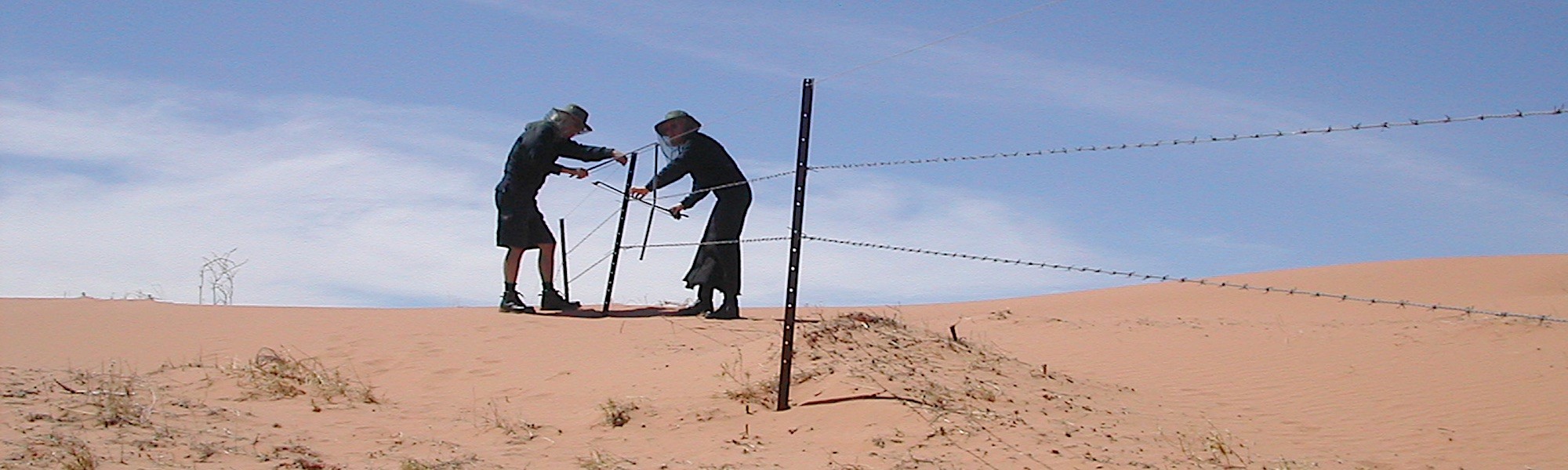
'Barbed wire and electric currents are no barrier for the English-born experimental musician Jon Rose and his partner Hollis Taylor. The world’s longest fence starts in the green fields of Queensland’s Darling Downs, snakes across the red, arid inland and ends on an ocean cliff in South Australia...the world’s longest string instrument, yielding haunting and elegiac sounds.
“It seems like a fence is probably just one sound but in fact it’s an extraordinary reservoir of sonic possibilities,” Rose says at his home in Alice Springs, the remote desert town in Australia’s red centre. “Apart from the harmonic series that is available on any string instrument, it’s got all kinds of rattles, buzzes [and] percussive sounds — it’s an incredible resource.” Some fences sound high-pitched, like sirens, while others with uneven barbed wire are lower, coarse and bass-like.
“An aspect of the barbed wire that appeals to me is that it becomes very clear where the notes are — if you miss them, it’s quite painful,” Rose writes in Post Impressions, the book in which he and Taylor chronicle their three-year odyssey playing fences and explain the lure wire holds in the unexpected, often melancholic sounds a vast fence produces. Not even electric fences are off-limits. “I have received some mighty shocks up the arm,” Rose says. “On the other hand, the surging current can produce rhythmic clicks and pops.”
The couple have been warned off the perimeter fence of the nation’s most secretive intelligence gathering base — Pine Gap, outside Alice Springs, operated jointly with the US — and stopped by police officers, curious as to why they were recording sounds near the Australian military’s secretive rocket base at Woomera.
“One day, when I was out near Broken Hill [in New South Wales] a penny dropped,” Rose says. “I realised the entire continent was covered with long string instruments, miles and miles of these fences, and you’ve just got to get out there and play them.”
In August he and Taylor were recognised as music visionaries, winning Australia’s coveted Richard Gill award for distinguished services to music.
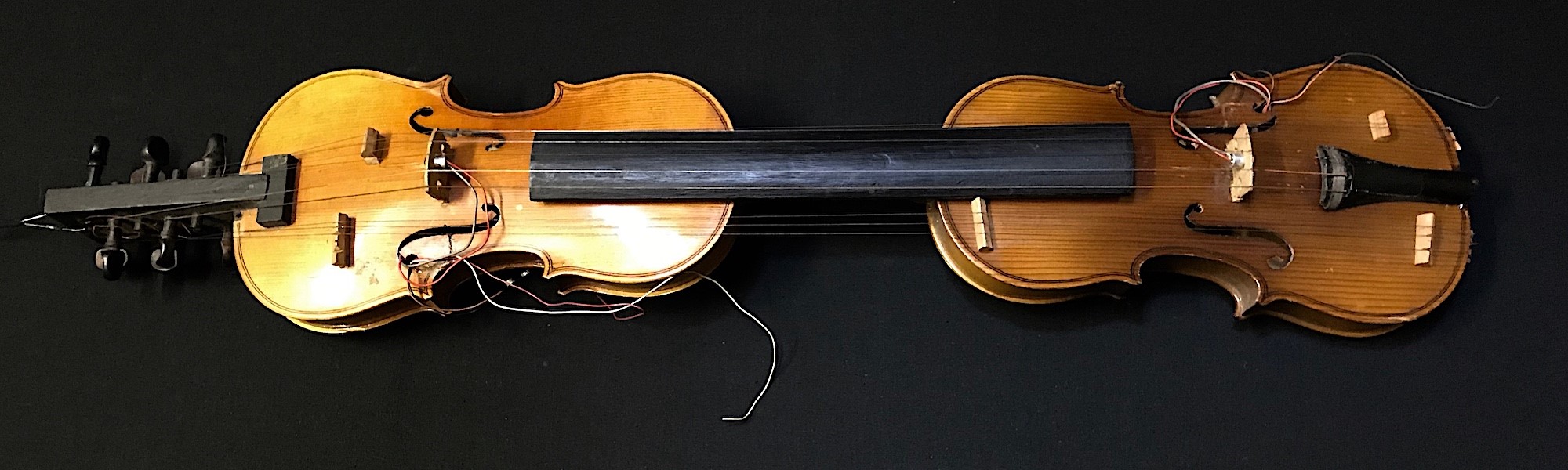
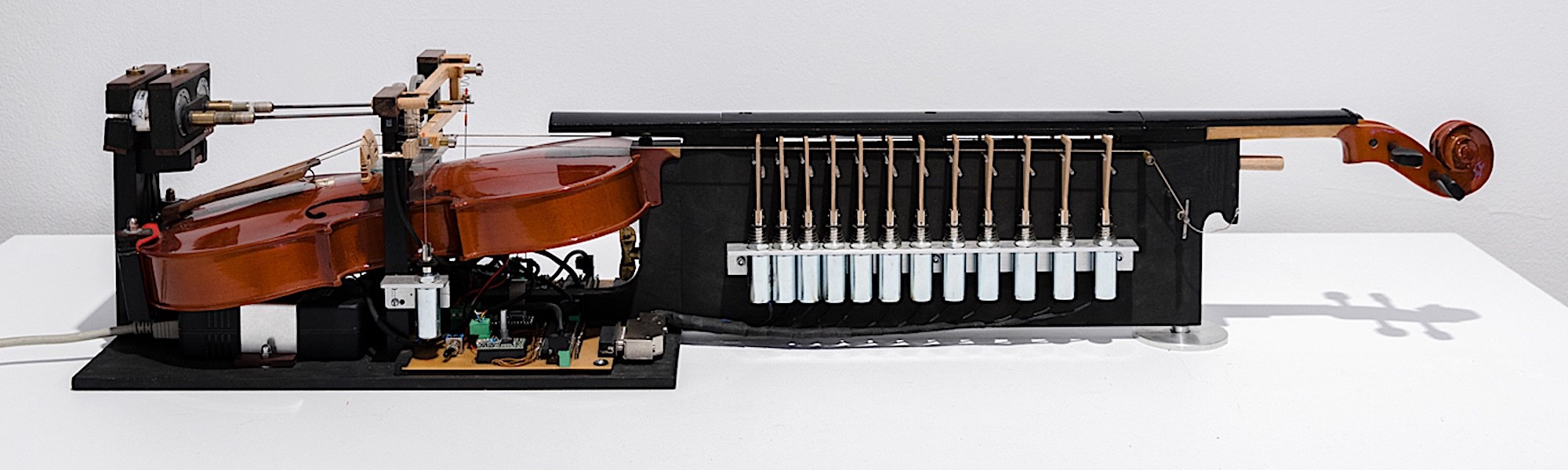
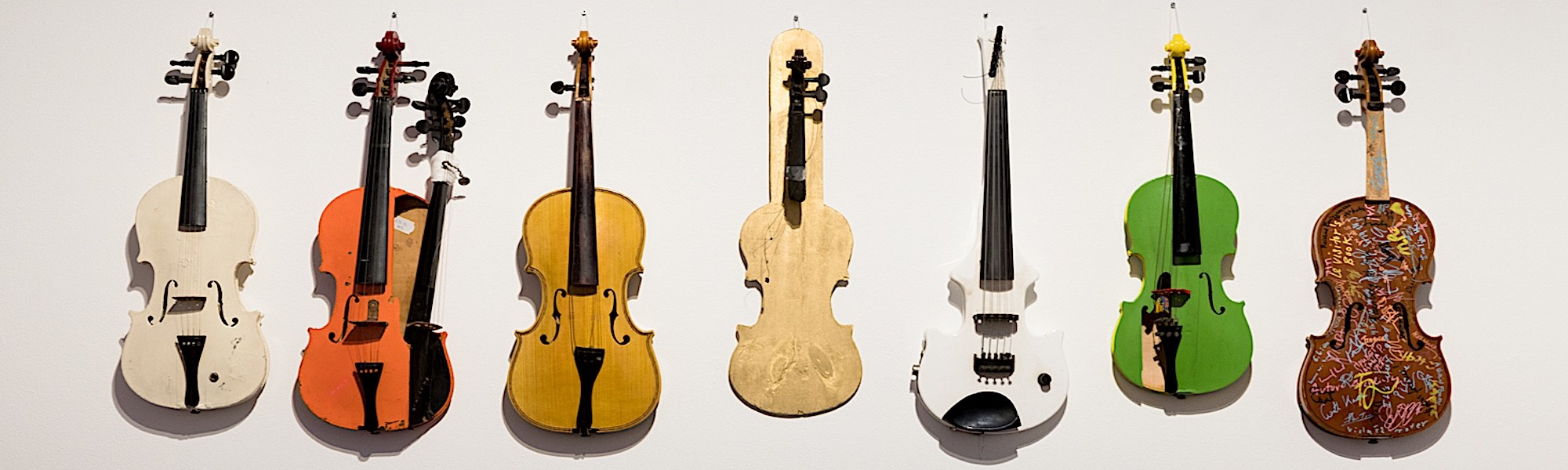
The couple’s property in Alice Springs houses the Rosenberg Museum, a monument to the violin in all its guises. Many of the exhibits are the result of Rose’s restless tinkering with violins, creating new instruments such as the data violin robot, which plays data generated by trading activity on Wall Street.
It fits with Rose’s idea of the violin as an unfinished experiment - much like his life.
The London Times
'Drummer Paul Lovens came out of the parallel and often overlapping free improv conjurings in Germany and around the same time, England-born violinist and conceptual artist Jon Rose was planting seeds in Australia. They joined forces with Bailey for a trio in 1992 in a series Rose booked at the Berlin venue Podewil. It seems to have been a good day for them. The playing is exemplary and the interactions fast and bold over the course of several improvised pieces. The concert was preceded by a lecture on chaos (theory) accompanied by Rose on 19-string cello which, perhaps, set the mood.
Also included in the set, at Rose’s request, was a solo piece by Bailey, whose appearances in Berlin were apparently scarce. In an insightful program note for the concert (and republished on his website), Rose wrote: “If Jimi Hendrix’ major contribution to guitar playing was the sophisticated manipulation of amplified sound through movement in space (i.e. controlled feedback), then Derek Bailey’s main influence has probably been his use of the harmonic series as the main structure for pitch events and melodic invention...Bailey introduced and developed the Klangfarbenmelodie concepts of the Second Viennese School into an improvised guitar language.”
Bailey’s playing is easily one of the most recognizable among guitarists, and it’s not all attitude, though that adds to the charm. His music is engaging and challenging, and it’s a pleasure to still be hearing it anew. For more info visit thejonrosearchive.bandcamp.com
New York City Jazz Record
'The first thing Band Width challenges is not the idea ofensemble, but the very way we understand presence. The sound of this album is not born in a shared space, but in a "between" - an electrical interstice, a temporal fissure — where playing means inhabiting two spaces simultaneously: the physical one and that of traveling sound. Band Width thus becomes a sensitive thread stretched between two extremes of the planet: the deserts of Alice Springs and San Diego.
The desert here is not a romantic backdrop, but an acoustic condition: deserts that cannot be seen, but listened to from afar. No foothold, no stable metric; waves of sand that bend and distort the sound. Playing "from the desert" means accepting that the echo does not coincide with the intention. In this sense, Band Width is a profoundly geological record: layered, crisscrossed by grooves, traversed by irregular tremors. The surface is ignited by sudden shifts, but the time that sustains them remains profound. The sound does not flow: it surfaces, explodes, retreats. Band Width is the medium that becomes flesh.
Rose, the heretic of the bow, enters this space as he has always done: by putting the instrument under pressure. The violin, in his hands, is never a given object; it is an unstable force field, a tool to be dismantled to see how much it holds up. Every passage of the bow is an act of mediation: between force and resistance, between intention and listening. Every sound seems to ask: "How far can I bend before I break?" Those familiar with The Fence will recognize this posture: the string as a line that simultaneously measures the world and questions it. Here, that line crosses not a physical territory, but a network. And the network, like any landscape, introduces unexpected friction.
Dresser responds from another latitude, but not from another mindset. His double bass does not accompany, it does not support according to conventional patterns, and it does not "dialogue" in the polite sense of the term. He works with the gravity of the sound, relying on its ability to sustain the very space of the gesture. His strings do not seek a chord: they seek a position. Each note seems to probe the unstable ground on which it rests. Intonation, here, is not merely a matter of pitch, but of attention and placement within the sonic gesture, beyond the expanded dimension of transmission.
The radicality of Band Width lies in the fact that this music never attempts to mask distance. Latency is not corrected; it is heard, especially by those on the other end of the sound. Micro-phase shifts become the nerves of the discourse. Improvisation doesn't adapt to technology: it incorporates it as an element of risk. It's hardcore improvisation because it accepts the possibility of failure as compositional material. There's no nostalgia for "everyone in the same room." The room is the planet. Time zones, distances, and latencies don't erase the possibility of a meaningful relationship, as demonstrated by every dialogue that traverses time and space without losing intensity. What falters is not the order of the world, but the idea that temporal coincidence is a necessary condition of meaning. Community (being-with) isn't guaranteed by proximity, but by a shared responsibility to listen. This gives rise to an idea of community that is not geographical but elective, founded not on alignment but on intensity. Not those who are close, but those who are willing to hold the other's time through a quality of embodied attention, capable of listening without anticipating and acting without occupying.
The New Noise (Italy)
'Is this the sound of music from another dimension?
I first wrote about Jon Rose 43 years ago. While I have the misfortune to be 43 years older, his art is not. It is still just as fresh, funny, surprising, beautiful, subversive, inventive and defiant. The defiance is intrinsic. Rose has devoted his life to making music that shuns idiom, most often, as here, via free improvisation.
At 75, he is an internationally celebrated figure, which no doubt warms his heart, but changes nothing when he picks up his violin; when the aural canvas is initially just as blank as it ever was, and every performance is an adventure into the unknown.
Given he has lived in Alice Springs for some years, this was a rare Sydney appearance at the quirky venue of publisher Nick Shimmin’s loungeroom, which he opens to experimental artists and an email list-only audience.
For it, he chose a decades-long collaborator in saxophonist Jim Denley and a more recent one in double bassist Clayton Thomas. Like Rose, both have a virtuosity that climbs beyond mere facility and into the outer reaches of what is possible on each instrument.
To sit only a metre or two from them is to be swept into an intoxicating theatre of sound, since watching them make the music is as enthralling as the music itself. Process and outcome are one and the same. You could variously watch Thomas playing his bass with two bows, sometimes both in one hand, sometimes one in each, above and below the bridge; or Denley using a pot lid on the bell of his alto, making a scraping or vibrating sound while also semi-muting the horn; or Rose using his violin as a percussion instrument of boundless potential.
While all three naturally sought ways to enhance what was happening, Rose, in particular, used his slippery, spidery violin to subvert anything in danger of entering a cul-de-sac of predictability.
It could be music you bathed in, or clung to as it took you for a tumultuous ride, and always it was music of contrasts: of extremes of pitch; of unfamiliar textures; of fragmentary rhythms and elusive tonal centres.
Then would come a moment of blinding beauty, as of a melody heard in a distant, unattainable past. Each player intuitively dropped out here and there to leave intricate duets, and one of these, between Rose and Denley, was so texturally startling it was like music from another dimension.
The interaction was routinely uncanny. Partly, of course, it’s a matter of intense listening to each other, but also of freakish convergences. In one memorable section of the second set, the violin and alto cried plaintively over massive, granite-like pillars of bass sound.
Another section had Denley growling into his saxophone, Rose sounding like a creaky house in a gale, and Thomas a forewarning of the apocalypse, before all three suddenly retreated to the merest wisps of sounds, and then to just the ghosts of those wisps.
Sydney Morning Herald & The Age, Melbourne